The Aesthetics Age
Or, how vibes are everything now
 · AI Assisted
The logical result of Fascism is the introduction of aesthetics into political life.
This is the situation of politics which Fascism is rendering aesthetic. Communism responds by politicizing art.
Walter Benjamin, The Work of Art in the Age of Mechanical Reproduction (1935)
In the summer of 2025, an 11-year-old boy from Riau, Indonesia became the coolest person on the planet.
His name is Rayyan Arkan Dikha, and he is a togak luan — the dancer who stands at the very tip of a long wooden racing canoe during the Pacu Jalur boat races, signaling to everyone watching that his team is in the lead. While dozens of rowers behind him paddle for their lives, he does a small, completely unbothered dance. Sunglasses on. Black Malay outfit. Hands flicking like he’s waving away a mosquito.
He didn’t win anything. He didn’t say anything. (He later told reporters that the dance was “just spontaneous — no learning, no practice.” Of course it was.)
Within a week, Paris Saint-Germain was posting their own version. Then Travis Kelce. Then Neymar. Then everyone.
The internet had a name for what he was doing: aura farming. The art of looking like the main character without appearing to try.

Meanwhile, halfway around the world, the most powerful government on Earth was doing the exact same thing — just with slightly worse dance moves.
OK, so how exactly are these two facts related?
I believe they’re both symptoms of the same shift — one where how something looks has quietly overtaken what it does. We used to live in the Information Age. I think we’ve left it. Information is free, infinite, and mostly ignored. What’s scarce now is the thing that makes you stop scrolling.
Welcome to the Aesthetics Age.
In short, as America becomes more authoritarian and building becomes nearly free, aesthetics will matter more than anything else — more than policy, more than argument, more than facts. This is a dark age for political scientists. It may also be the golden age for designers.
Let’s dive in.
Part I
The Feed
Let’s start with the official accounts — and to appreciate how strange they’ve become, you have to remember what the White House used to post like.
Here’s the Obama White House in 2011, campaigning for a payroll tax cut extension. On the right is the same account, fourteen years later:
One of these is asking you about a tax policy. The other is a man in a cape. (It was posted the week James Gunn’s Superman came out, right after Gunn had called Superman “an immigrant” in an interview. I’m sure that was a coincidence.)
Even when the old White House got petty, it got petty like an accountant. In August 2022, when Republicans attacked Biden’s student loan forgiveness, the most savage thing the Biden White House could think to do was post a number. Compare that to the post from March 2025, right in the middle of the internet’s brief obsession with turning every photo into a Studio Ghibli frame:
That’s a real woman, Virginia Basora-Gonzalez, being arrested in Philadelphia, redrawn in the style of the studio whose founder once called AI-generated animation “an insult to life itself.” It got tens of millions of views in a day. The PPP tweet was a spreadsheet. This one was an anime.
A month earlier, they’d posted this:
Chains being pulled out of a basket. Handcuffs clinking on a tarmac. Cut and sound-mixed like a relaxation video.
I could keep going. There was the AI-generated image of Trump as the Pope, posted days after Pope Francis’s funeral. There was “Chipocalypse Now,” an Apocalypse Now parody about sending troops to Chicago (“I love the smell of deportations in the morning”). And there’s the Department of Homeland Security, which spent the summer of 2025 posting Thomas Kinkade paintings and vintage Uncle Sam posters with captions like “Protect the Homeland” (the Kinkade family was not thrilled).

Here’s the thing: none of these are arguments.
You can’t fact-check a Ghibli frame. You can’t rebut a vibe. And the irony is load-bearing — if you object earnestly, you’re the one who looks ridiculous. The post wins the moment you get mad at it.
This is aura farming, at the scale of a nation-state.
The internet, to its credit, has noticed. The best response I’ve seen wasn’t an op-ed. It was a meme:
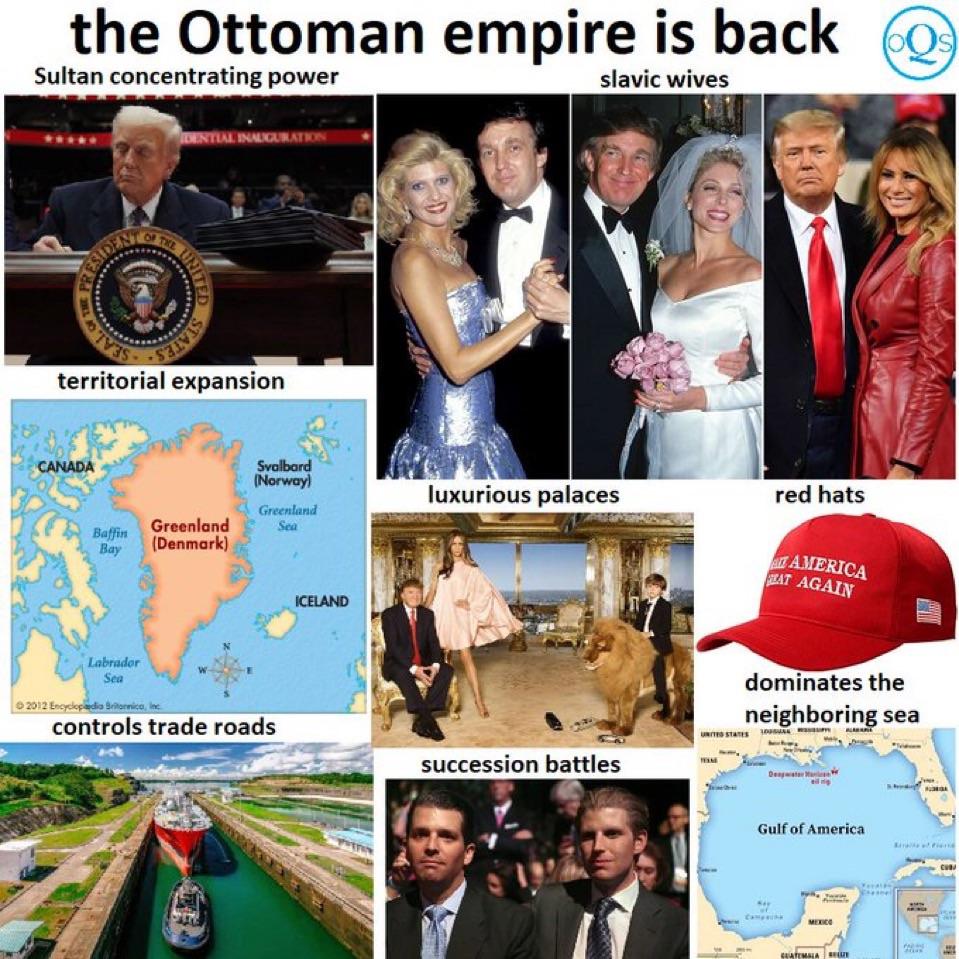
Which is funny — and, like all good memes, a little too accurate. Because the aesthetic didn’t stay on the timeline.
The Frame
Political careers used to be built on speeches. Now they’re built on frames.
On August 24, 2023, Donald Trump was booked at the Fulton County Jail and photographed. A mugshot is supposed to be a humiliation — the single worst photo anyone will ever take of you. Instead, it became the most merchandised image of the entire campaign. T-shirts. Mugs. Trading cards.
Then, on July 13, 2024, in Butler, Pennsylvania: blood on his face, fist in the air, an American flag directly overhead, Secret Service agents piled around him like figures in a Baroque painting. AP photographer Evan Vucci took the photo, and within hours, people were comparing it to this one:

Neither the mugshot nor the Butler photo argues for anything. Neither one contains a single policy position. And yet each one did more for its subject than any platform could have.
That’s the whole game now. The frame is the argument.
And once you’ve won with a frame, the natural next step is to hang it on a wall. In gold.
The Marble
In October 2025, the entire East Wing of the White House — built in 1902 — was demolished in a matter of days to make way for a 90,000-square-foot ballroom. That’s bigger than the White House itself (55,000 square feet). The price tag started at $200 million and grew to $300 million, all reportedly paid for by private donors. Back in July, Trump had promised it “won’t interfere with the current building.” In October, he explained that “in order to do it properly, we had to take down the existing structure.”
Meanwhile:
- The Oval Office got covered in gold trim.
- The Rose Garden got paved over into a patio.
- The West Colonnade got a Presidential Walk of Fame: gilded portraits of every president, with plaques underneath written in a style you may recognize.
- In August 2025, Executive Order 14344, Making Federal Architecture Beautiful Again, declared that in Washington, “classical architecture shall be the preferred and default architecture for Federal public buildings.”
- That October, Trump showed off a model of a triumphal arch to be built across the Potomac from the Lincoln Memorial. Official renderings followed in April 2026. (A triumphal arch. In 2026. We’ll come back to this.)
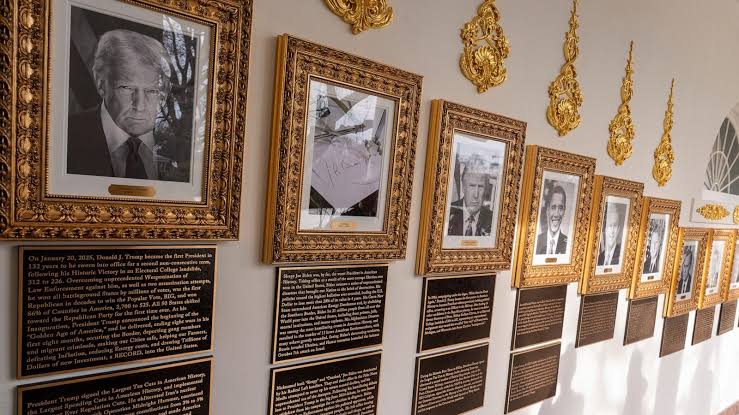
To be fair, America has always been like this.
When I visited Washington, D.C. in 2024, the thing that struck me most wasn’t any one building. It was how completely classical the whole city was. Columns, domes, pediments, Latin mottos. The Founders didn’t just admire Greece and Rome — they cosplayed them. They named the Senate after Rome’s. They built the Capitol on a hill and named it after the one in Rome. They called their new country a republic, after the Roman one, and filled it with men who wrote under pen names like “Publius.”
They went as far as to depict George Washington as an American Zeus:
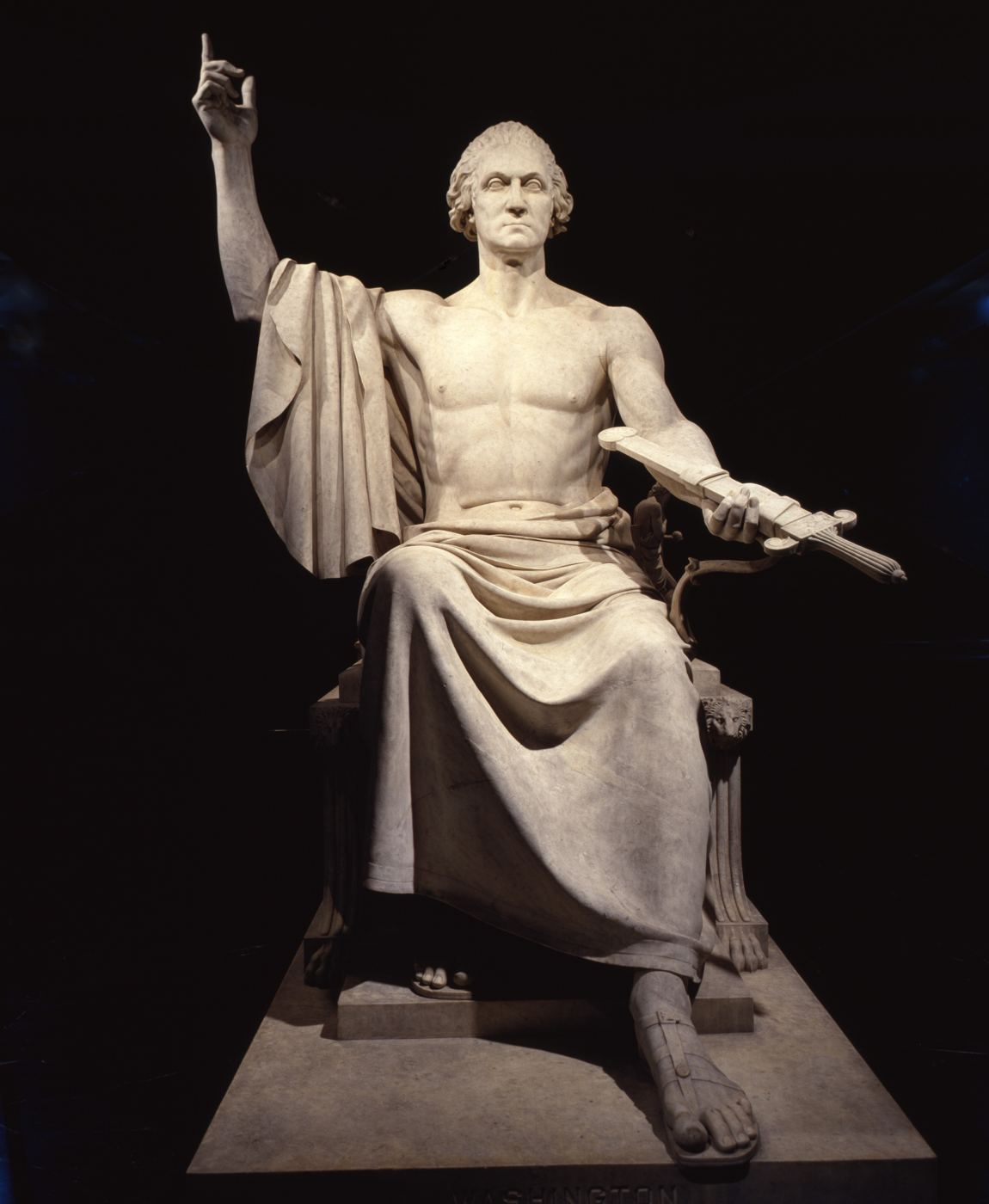
And just in case that wasn’t enough, look up inside the Capitol dome:
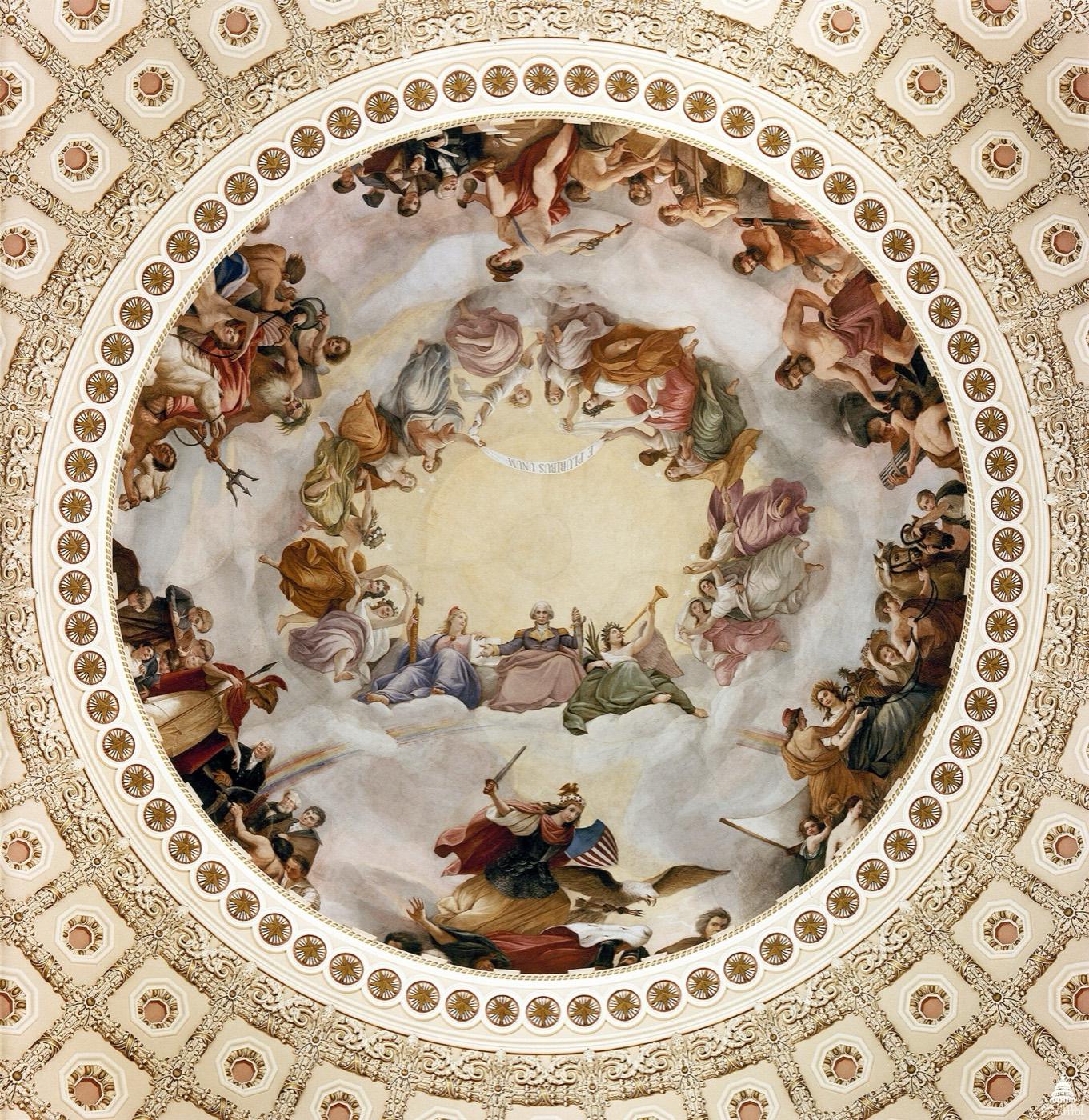
So the classical revival isn’t new. What is new is the scale of the ambition.
In his first term, Trump ordered a National Garden of American Heroes: a park filled with statues of great Americans, from the Founders to Kobe Bryant. Biden canceled it. In January 2025, Trump brought it back, now with 250 statues — one for every year of the country — and Congress set aside $40 million to pay for them. In May 2026, he announced it would go in West Potomac Park, right next to the National Mall. As of this writing, there’s a site, a lawsuit, and no garden.
If this sounds familiar, it’s because someone already did it. In 221 BC, Qin Shi Huang unified China and became its first emperor. One of his first acts, according to the historian Sima Qian, was to confiscate the weapons of every state he had just conquered, haul them to his capital, and melt them down into twelve colossal bronze statues. A monument to unity, made out of everyone else’s ability to resist.
He also built a big, beautiful wall on the northern border. History does not record whether the Xiongnu paid for it.
To his credit, Trump’s version is more inclusive: 250 statues instead of 12, all life-sized, and not one of them made of confiscated muskets. Yet.
And it’s not just the government.
On October 2, 2026, a French foundry called Atelier Missor finished assembling a 50-foot bronze statue of Prometheus just outside SpaceX’s Starbase in Texas. SpaceX didn’t commission it, and Elon Musk didn’t pay for it — the foundry reportedly spent around a million dollars of its own money, because they thought it should exist. Mother Jones described them as a studio promising “art so epic it will raise the birthrate.” Their announcement read: “People of the West, we have lived through an era devoid of dreams, devoid of destiny.”
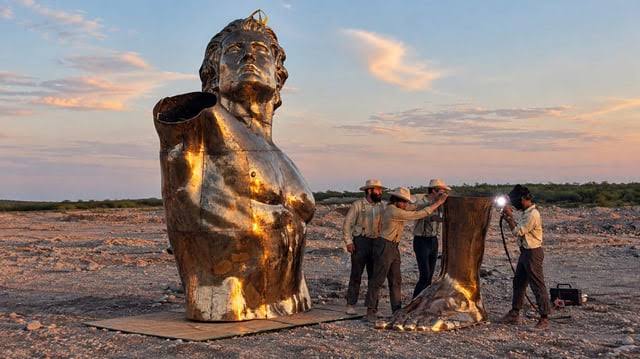
When photos of the finished statue went up, the replies filled with armchair anatomists. The legs are too short. The torso is too long. The head is too big.
Here’s the thing: I’m fairly sure that’s on purpose. Michelangelo did the exact same thing 500 years ago:
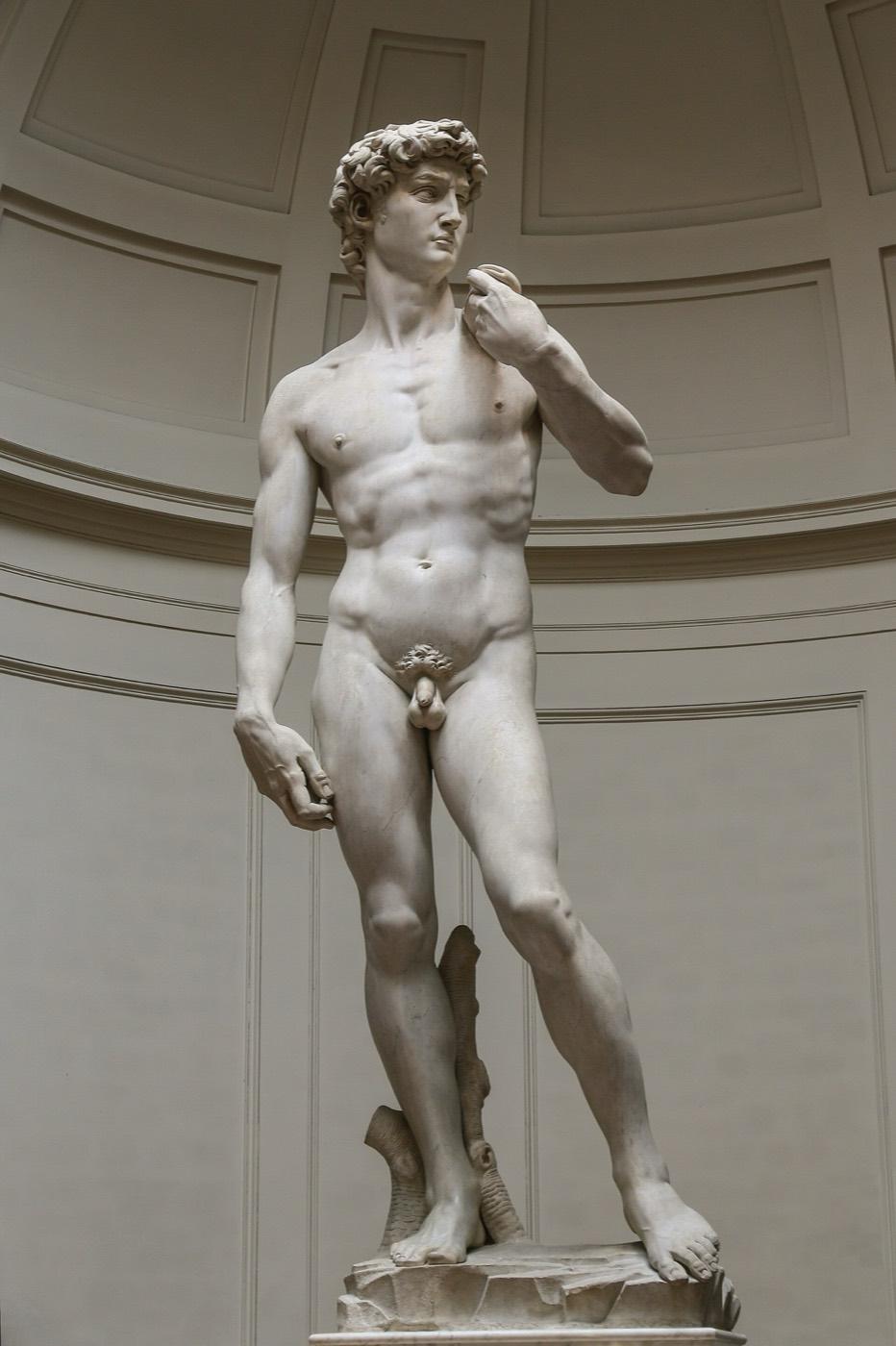
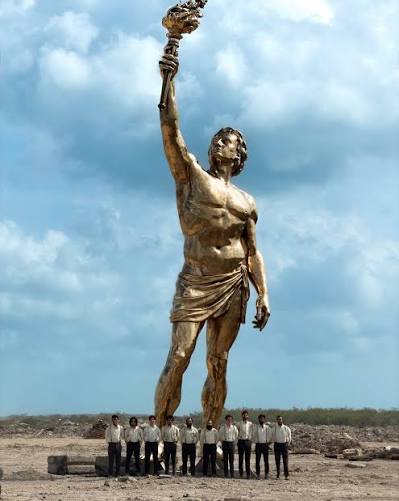
David’s head and hands are famously too big for his body. That’s because he was originally meant to stand high up on the roofline of a cathedral, where people would only ever see him from far below. From down there, perspective shrinks whatever is farthest from your eye — the head, the shoulders, the raised arm — so the sculptor makes those parts bigger to compensate. When you’re standing at the feet of a 50-foot statue, the legs are right in front of you, and the head is five stories up. Give it “correct” proportions, and it looks like a pinhead.
In other words, the statue isn’t built for the photo. It’s built for the person standing underneath it, looking up. Which, if you think about it, is the entire point of a monument.
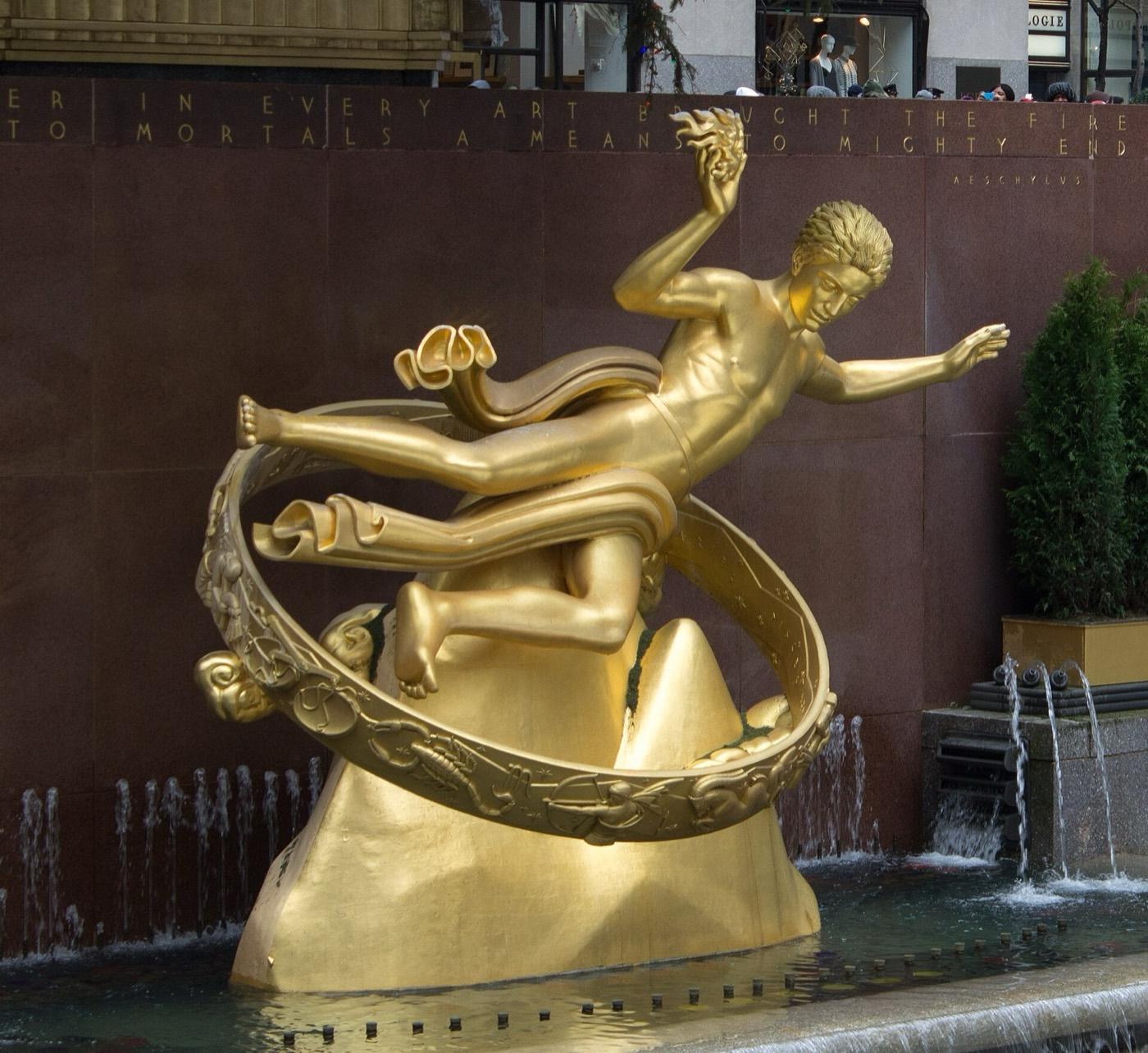
Not to be outdone, a crypto entrepreneur has proposed a 450-foot Prometheus for Alcatraz Island. Taller than the Statue of Liberty. Presumably with even shorter legs.
The Beard
If the buildings are getting the classical treatment, it was only a matter of time before the bodies did too.
On September 30, 2025, Secretary of War (yes, it’s called that again) Pete Hegseth summoned hundreds of generals and admirals from around the world to Quantico, Virginia, and told them this:
This also means grooming standards. No more beards, long hair, superficial individual expression. We’re going to cut our hair, shave our beards, and adhere to standards.
No more beardos. The era of rampant and ridiculous shaving profiles is done.
Pete Hegseth, Quantico (2025)
Whatever you think of the policy, notice what kind of policy it is. It isn’t about budgets, or strategy, or procurement. It’s about how soldiers look. He even justified it with the “broken windows theory” — the idea that if you let the small, visible things slide, the big things eventually follow.
The state is art-directing its own army.
Part II
Have We Been Here Before?
Do you see the pattern yet?
Gold. Marble. Columns. Triumphal arches. Giant statues of Greek titans. A government that cares deeply about what its soldiers’ faces look like.
If this all feels oddly familiar, it’s because it is. There are two historical moments that the Aesthetics Age keeps reaching back toward, and they could not be more different from each other: the Renaissance, and Fascism.
And behind both of them, as always, are the Romans (wow, we really can’t get enough of the Romans, can we?). We’ll save them for last.
The Bankers
In the 15th century, one of the richest cities in Europe was officially a republic. Unofficially, it was run by a family of bankers called the Medici, who controlled it for most of the century, often without holding any formal title at all. Sound familiar?
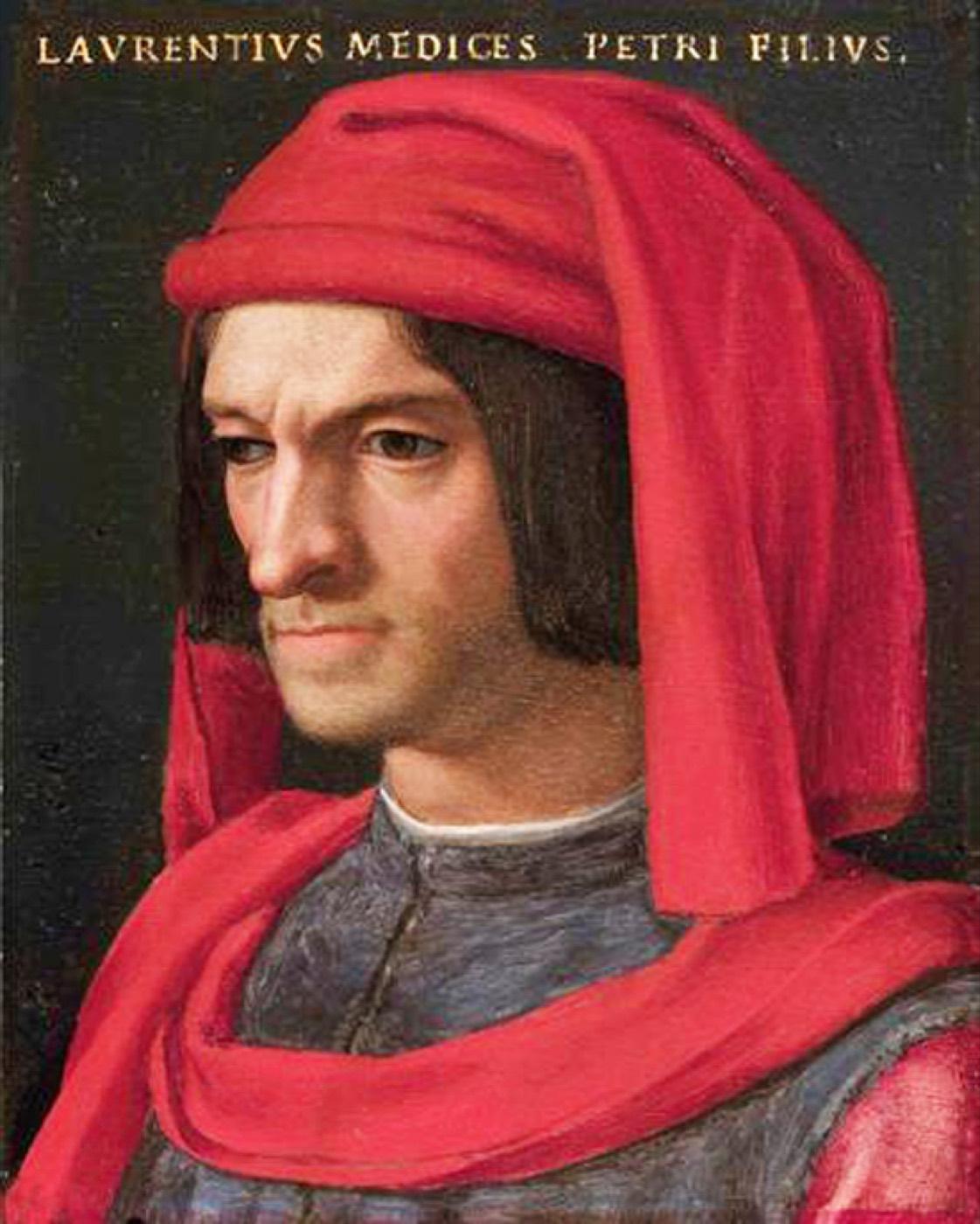
The Medici didn’t win legitimacy through elections. They bought it — with art. They funded Brunelleschi, Donatello, Botticelli, and a teenage Michelangelo, who Lorenzo de’ Medici took into his own household. Their coat of arms was everywhere, so nobody could forget who’d paid for all this beauty.
The crown jewel was this:
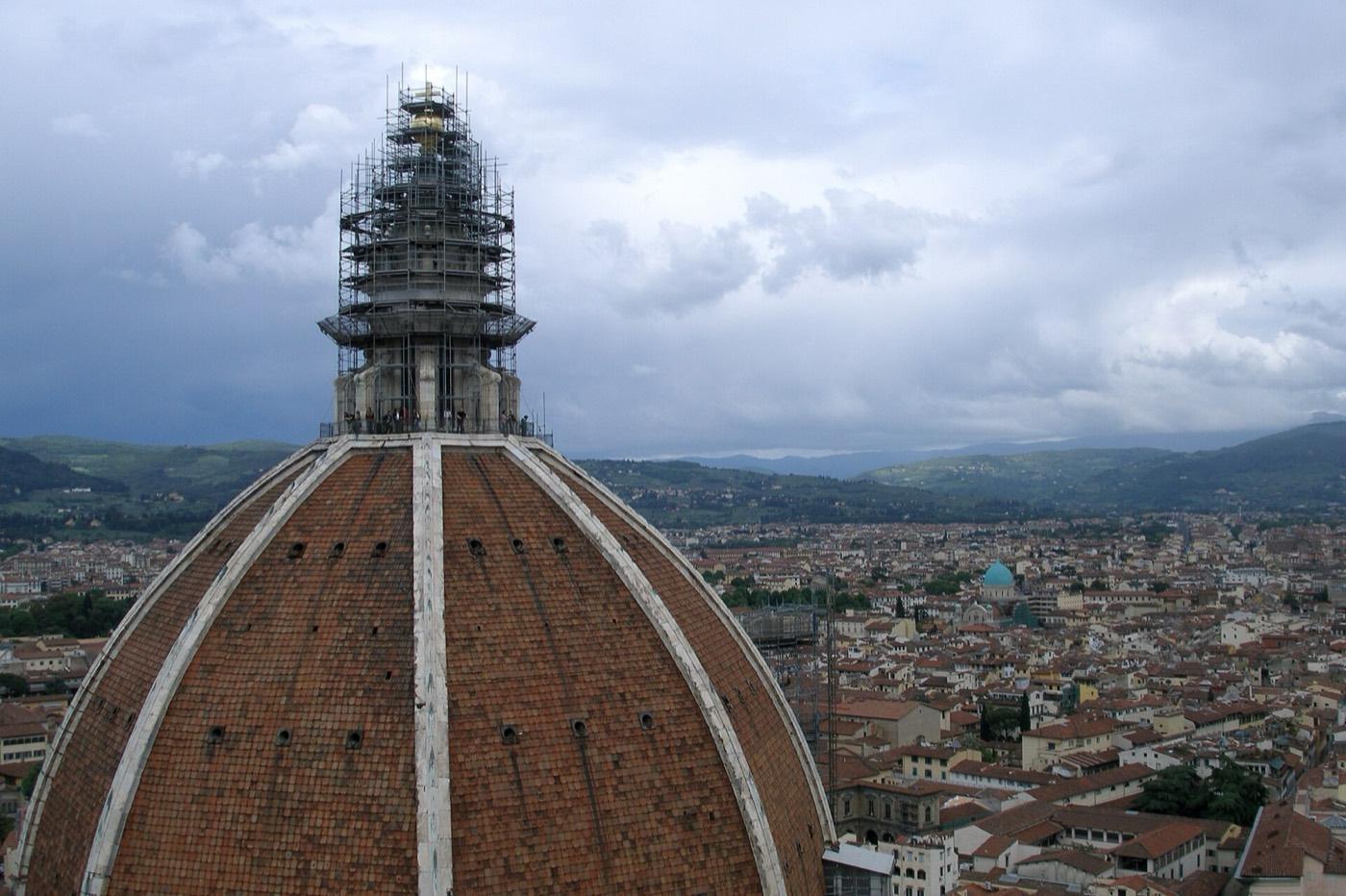
The cathedral had been sitting there with a giant hole in its roof for decades, because nobody alive knew how to span it. So the city held an open competition in 1418, and a goldsmith named Filippo Brunelleschi won it with an engineering solution nobody had ever seen. The dome was the 15th-century equivalent of a moonshot — and a flex aimed squarely at the neighbors.
In short, the Renaissance was a PR campaign by a family of bankers — and it gave us some of the most beautiful things humanity has ever made.
Rome, Again
That’s the flattering parallel. Here’s the other one.
In the 1920s and ’30s, Benito Mussolini built Fascist Italy around a single aesthetic idea: Romanità, or “Roman-ness.” Italy was going to be Rome again — and it was going to look like Rome again. Mussolini even had old neighborhoods bulldozed to clear sightlines to ancient ruins.
His most ambitious project was an entire new district in the south of Rome, called EUR, built for a World’s Fair scheduled for 1942. At its center was this building:
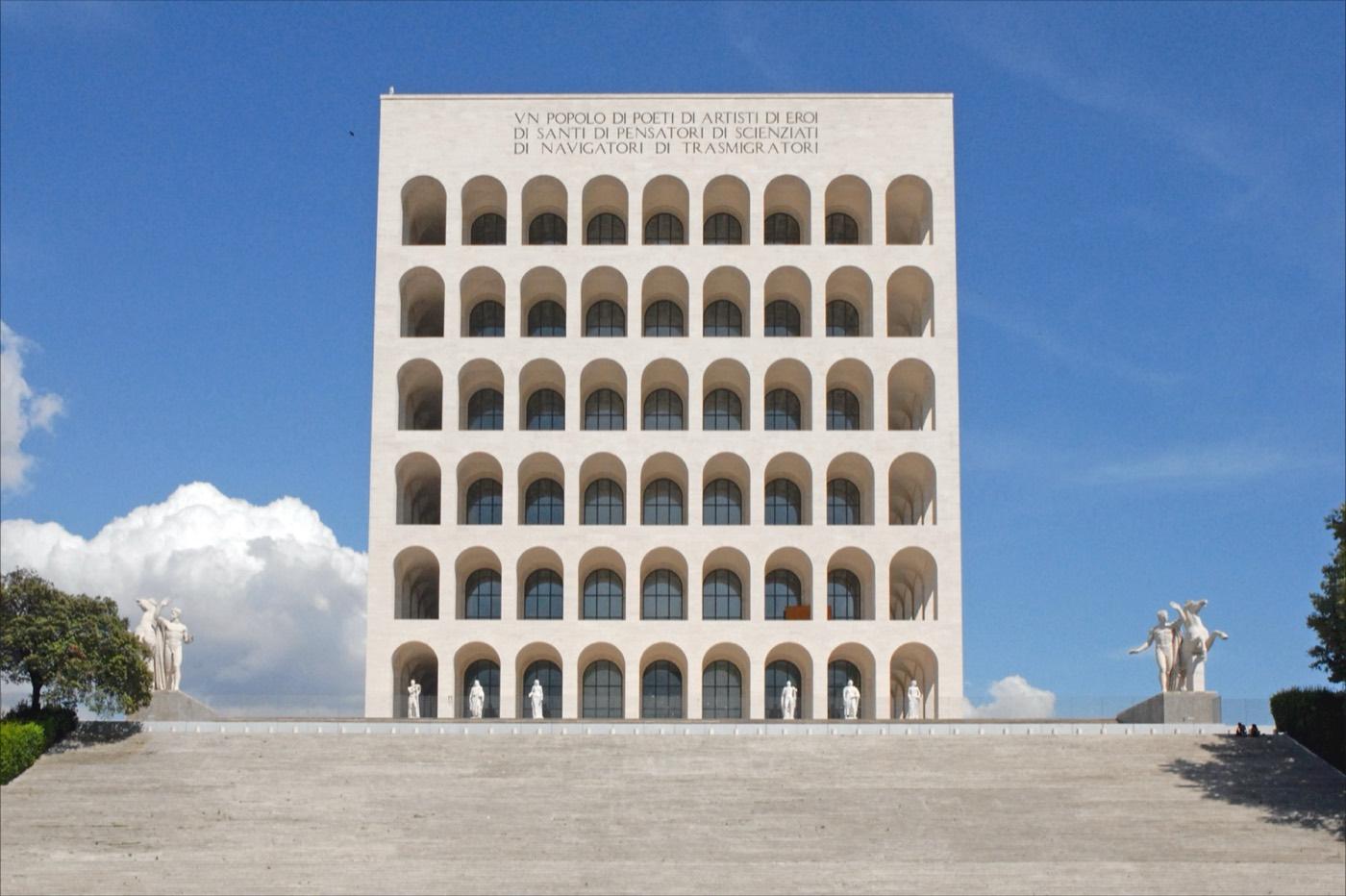
Around the top, carved in enormous letters, is a line from the speech Mussolini gave announcing his invasion of Ethiopia: “A people of poets, of artists, of heroes, of saints, of thinkers, of scientists, of navigators, of migrants.”
Meanwhile, in Germany, Hitler’s architect Albert Speer was designing rally grounds in Nuremberg. His most famous work wasn’t even a building. It was this:
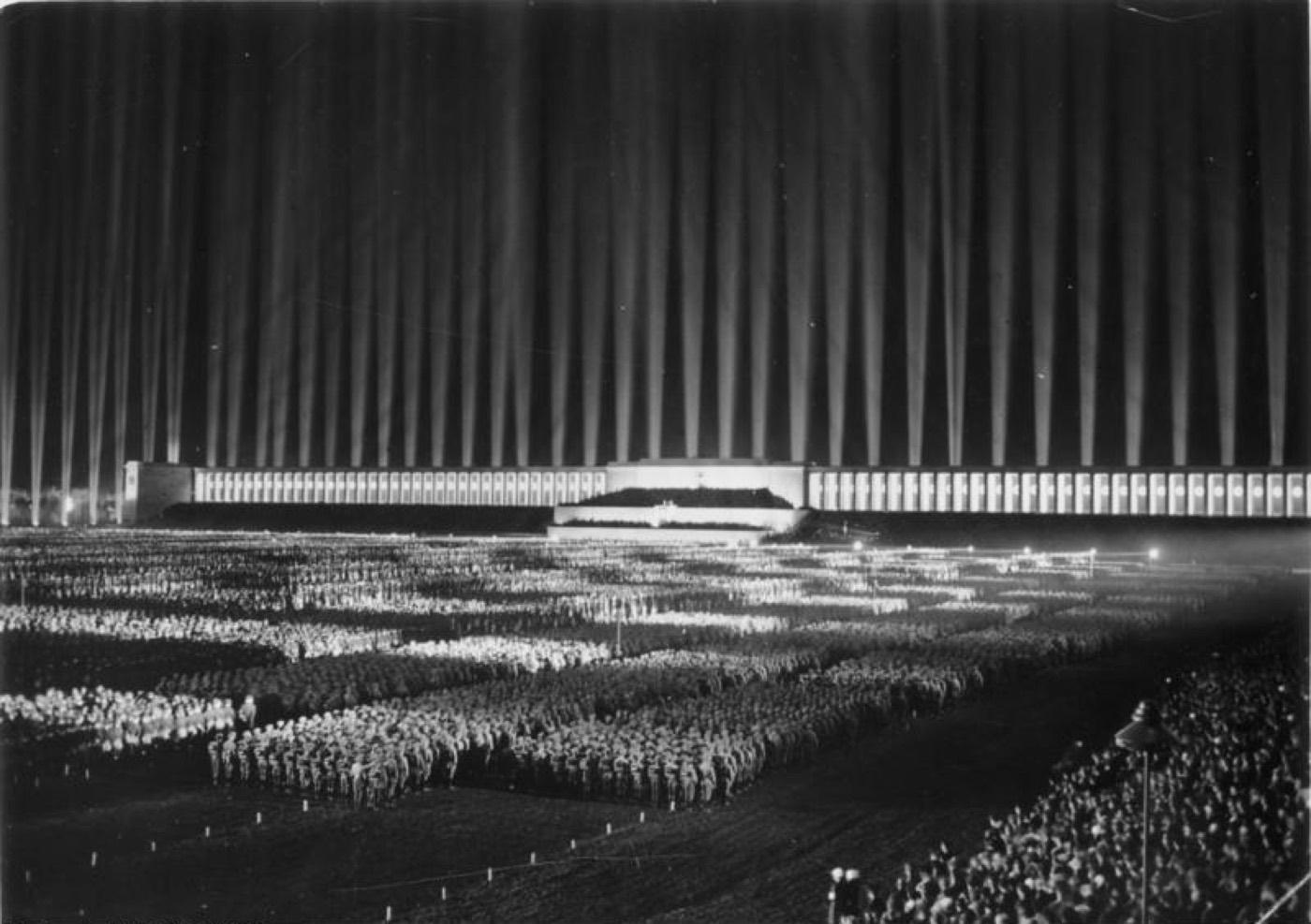
Speer also had a theory he called “ruin value”: that the Reich’s buildings should be designed so that, thousands of years later, their ruins would still look magnificent — like the Roman ones.
The biggest of them all was the Volkshalle, the “People’s Hall,” planned as the centerpiece of Hitler’s new capital, Germania. Hitler sketched it himself in the 1920s. It was basically the Pantheon, scaled up until it stopped making sense: a dome roughly 290 meters tall, big enough to hold over 150,000 people, with an interior so vast that Speer worried the crowd’s breath would condense into clouds and rain on them. It was never built. The only piece that exists today is a giant concrete cylinder in Berlin that Speer poured to test whether the swampy ground could hold it. (It couldn’t.)
Leni Riefenstahl filmed the 1934 Nuremberg rally and turned it into Triumph of the Will (1935), still one of the most technically brilliant (and most horrifying) films ever made. This is exactly what Walter Benjamin was watching when he wrote the epigraph at the top of this essay. A regime that couldn’t give people real political power gave them a spectacle instead. Aestheticized politics. You don’t vote. You watch.
So Which One Is It?
So here’s the question: is the America of 2026 the Renaissance, or is it the 1930s?
Is the ballroom a Duomo, or a Volkshalle?
The answer is… both. Sort of.
Here’s the difference I keep coming back to. Ask who the art is actually for.
The Duomo was built for a city. It was awarded through an open competition. It took 16 years to build, and 600 years later, anyone can still walk inside it for free.
The Cathedral of Light was built for one night, for one man. Its entire purpose was to make the individual disappear into the mass. When the lights turned off, nothing was left.
Renaissance art outlives its patrons. Fascist art exists to glorify them.
By that test, the America of 2026 is a strange mix. The ballroom is a private room for a president’s guests, built by tearing down a public one. The arch is a monument to — well, it’s not entirely clear what yet. On the other hand, a French foundry spending its own money to put a bronze titan in the Texas desert is about as Renaissance as it gets.
The aesthetic is the same. The question is whether it ends up serving the many or the one.
But to really understand what’s going on, we have to go back to the people both of them were copying.
Arms and the Man
In 49 BC, Julius Caesar crossed the Rubicon with his army and started a civil war against the Roman Republic. He won, had himself named dictator for life, and was stabbed to death in the Senate a few weeks later. (The Senate, it turns out, also had opinions about aesthetics. Mostly about crowns.)
But Caesar had already understood something important. Long before he took power, he’d been telling everyone that his family, the Julii, were descended from the goddess Venus, through her son, the Trojan hero Aeneas. When he built his new forum in the center of Rome, the centerpiece was a temple to Venus Genetrix: Venus the Ancestor. His ancestor, specifically.
His adopted son, Octavian, took that idea and ran with it.
After winning his own round of civil wars, Octavian became Augustus, the first Roman emperor, in 27 BC. And he had a problem. Rome had been a republic for nearly 500 years, and Romans hated the idea of kings. So Augustus never called himself one. He was just the princeps — the “first citizen.” The Senate still met. Elections were still held. Everyone simply understood where the power actually was.
What he did instead was build. According to the historian Suetonius, Augustus boasted that he “found Rome a city of brick and left it a city of marble.” He commissioned the Ara Pacis, an altar celebrating the peace he’d brought to the Mediterranean (by winning every war first).
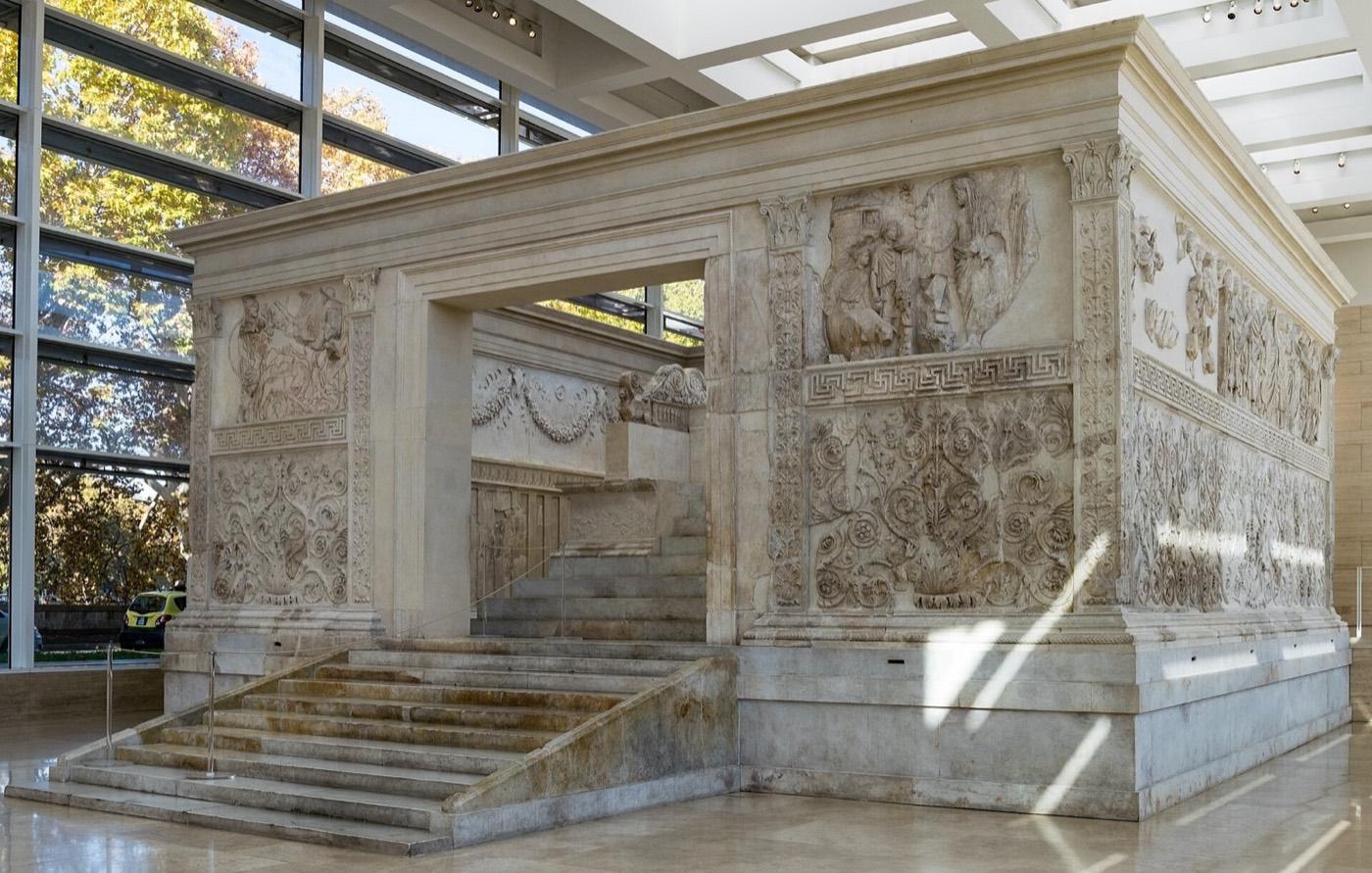
And he made sure every statue of himself looked exactly like this:
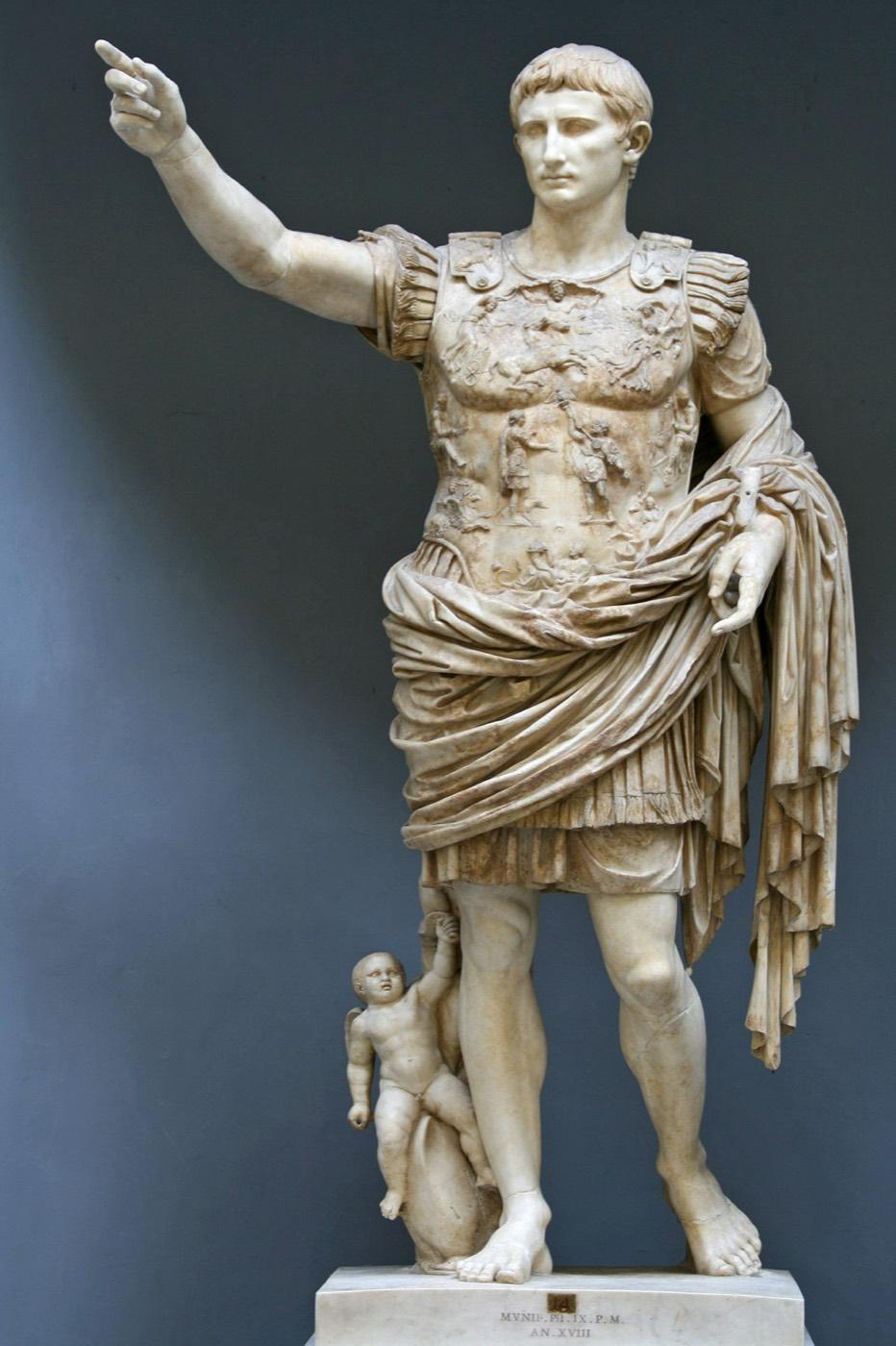
But the most important thing Augustus commissioned wasn’t made of marble. It was a poem.
Virgil’s Aeneid, written in the 20s BC with the emperor’s encouragement, tells the story of Aeneas fleeing the burning ruins of Troy and sailing west to found a new people in Italy. It’s an epic in the style of Homer, but its real subject is Rome — and specifically, Augustus. In the first book, Jupiter himself promises the Romans imperium sine fine: “an empire without end.” In the sixth, Aeneas visits the underworld and is shown a parade of future Romans, culminating in Augustus, who “will bring back the Golden Age.” In the eighth, Aeneas is given a shield engraved with the future, and right in the center is Augustus winning the Battle of Actium.
This is what historians call ethnogenesis: the creation of a people’s identity, complete with a founding myth. The Aeneid told Romans who they were, where they came from, and what they were destined to become. And it just so happened that what they were destined to become was an empire ruled by one man, whose family the gods had personally chosen. The Republic didn’t end. It was fulfilled.
Virgil died in 19 BC with the poem unfinished, and asked for the manuscript to be burned. Augustus overruled him. I think we can all understand why.
Augustus also passed laws penalizing Romans who stayed unmarried or childless, because he was worried about the birthrate. Two thousand years later, people are building 50-foot statues to fix the same problem. Some aesthetics are timeless.
Every one of these regimes was reaching for the same thing. Mussolini dug up the Ara Pacis. Hitler wanted a Pantheon you could fit 150,000 people inside. America has a triumphal arch on the way, a Garden of Heroes in court, and a poster of its president as Superman.
Augustus figured out something every ruler since has rediscovered: when you take away people’s political power, you have to give them something beautiful to look at instead. And a story about who they are.
Part III
The Coin
OK, enough about emperors. Let’s talk about venture capitalists. (Different togas. Same energy.)
Andreessen Horowitz — the firm that coined “American Dynamism” for its practice investing in defense, aerospace, and manufacturing — rebranded in 2025. Gone was the lowercase, apologetic, every-startup-looks-the-same sans-serif logo. In its place: a flourished Art Deco wordmark and a deep burgundy and navy palette. Fast Company called it an “Ayn Rand-style” brand.

They also made a coin:

Compare that to the tech aesthetic of the 2010s. You know the one: Corporate Memphis, flat illustrations of people with purple skin and enormous noodle limbs, every logo slowly melting into the same rounded geometric sans. That style was designed to offend no one.
The new one is designed to mean something — and specifically, to mean America.
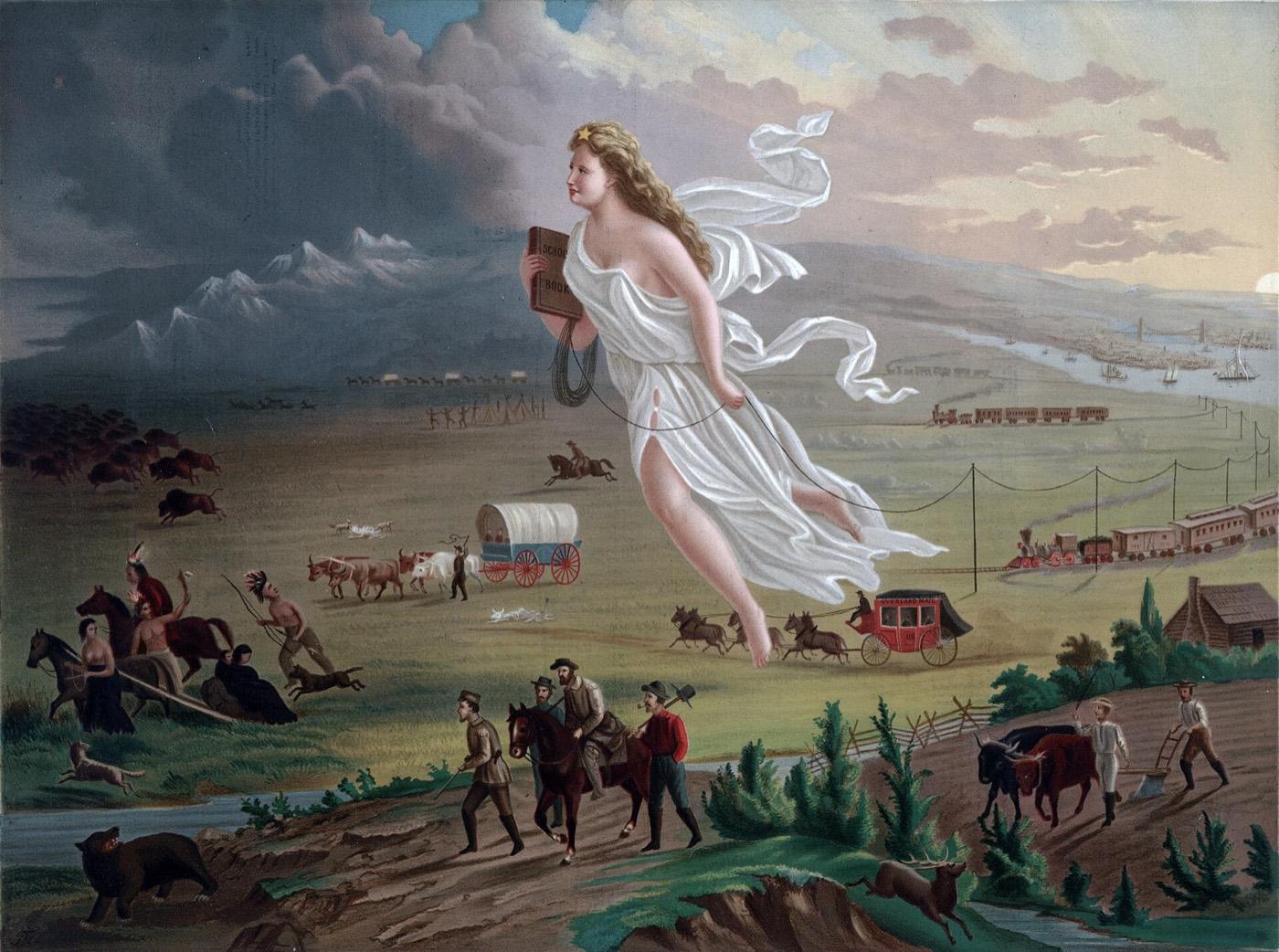
Then there’s Monumental Labs, a New York startup founded in 2022 that uses AI and seven-axis robotic arms to carve marble. The robots rough out the stone; human carvers finish the details by hand. Their pitch is to build “AI-enabled robotic stone carving factories” that make ornate, hand-carved-looking cities affordable again.
Which brings us to the real reason this is all happening now.
The Cost of Building
For most of the history of software, building was the hard part. Having the idea was cheap — everyone has ideas. What was scarce was the engineers, the money, and the time to actually make it.
That’s flipped.
In February 2025, Andrej Karpathy coined the term “vibe coding”: describing what you want to an AI and letting it write the code, without really looking at the code at all. A year and a half later, it’s not a joke anymore. A single person with a laptop can now ship in a weekend what used to take a funded team a quarter. (Yes, the robots carving the marble and the robots writing the code are, more or less, the same robots.)
When the cost of building goes to zero, the question is no longer can you build it? The question becomes: should this exist, and what should it feel like?
Taste
That’s why “taste” has suddenly become the hottest word in Silicon Valley. Scroll through tech Twitter for five minutes and you’ll see it more than you see the word “AI.” Founders say it’s the moat. Investors say it’s what they’re looking for. Job postings ask for it.
Paul Graham saw this coming more than twenty years ago:
Saying that taste is just personal preference is a good way to prevent disputes. The trouble is, it’s not true. You feel this when you start to design things.
Paul Graham, Taste for Makers (2002)
Do you see the parallels yet?
Politics and tech have arrived at the same place, for the same reason. When the substance gets cheap — whether it’s policy that anyone can promise or software that anyone can generate — the only thing left that’s scarce is the form.
You Have It or You Don’t
Here’s the part people don’t like to hear: taste looks a lot more like a talent than a skill.
We already accept this about programming. Everyone in tech knows that the “10x engineer” is real, even if nobody will say it out loud in a performance review. Some people see the structure of a problem instantly, and some never will, no matter how many bootcamps they take. Coding intelligence is unevenly distributed, and the entire industry quietly organizes itself around that fact.
Taste is the same kind of thing. Yes, you can train it — look at a thousand good things, make a thousand bad things, and slowly develop an eye. But the ceiling is set early, and it’s set unevenly. Some people walk into a room and immediately know what’s wrong with it. Some people will never be able to tell you why the Ghibli post feels so much worse than an actual Ghibli film.
(I say this as someone who has spent an embarrassing number of hours adjusting the easing curve on a single drawer animation. It still isn’t right.)
For most of history, that talent was underpriced, because the bottleneck was always somewhere else — engineering, capital, distribution. Now the bottleneck is taste. And the people who have it are about to become the most important people in the room.
Conclusion
I don’t think any of this is good news for democracy.
A politics that runs on aura is a politics where whoever has the best image wins. That should worry everyone — including the people who are currently winning, because aesthetics are a weapon anyone can pick up.
But it is, undeniably, a moment where design has more leverage than at any point in my lifetime. Political scientists are watching their models stop predicting anything. Designers are watching their work become the main event.
Augustus had Virgil. Every regime in the Aesthetics Age will need one too — except now Virgil is a designer, a meme account, a foundry, a startup with a robot arm, or a kid with a laptop and a good eye. Benjamin’s answer to aestheticized politics was to politicize art: to make the people holding the brushes take responsibility for what they paint. I think that’s still the right answer. If design is power now, then “I just made the assets” is no longer a defense. And Americana — the flag, the frontier, the wheat field, the marble — doesn’t belong to any one party. It belongs to whoever is willing to take it seriously.
Which brings me back to the kid on the boat.
The reason Rayyan’s dance went viral wasn’t that it was perfectly designed. It was that it obviously wasn’t. He wasn’t selling anything. He wasn’t trying to win an argument. He was just an 11-year-old having the time of his life at the front of a canoe, and you could feel it through the screen.
The best aura, it turns out, is the kind you don’t farm.
But again: this is all just the rambling of a random guy on the internet. Take it with a grain of salt.
Image credits: Pacu Jalur by Nocomentapapun (CC BY-SA 4.0); Ara Pacis by Rabax63 (CC BY-SA 4.0); Brunelleschi’s dome by Vyacheslav Argenberg (CC BY 4.0); David by Jörg Bittner Unna (CC BY 3.0); Palazzo della Civiltà Italiana by dalbera (CC BY 2.0); Cathedral of Light from the Bundesarchiv (CC BY-SA 3.0 DE); Prometheus by Balon Greyjoy (CC0); historical works in the public domain, via Wikimedia Commons. Photos of the Walk of Fame, Atelier Missor’s Prometheus, and a16z’s branding belong to their respective owners.